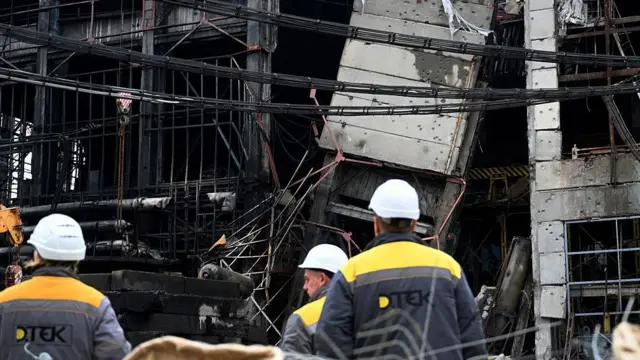
Ukraine is struggling to keep homes and businesses powered as Russia continues to target its energy infrastructure, the head of the country's largest private energy provider has said.
Maxim Timchenko, CEO of DTEK, revealed that the company has been operating in a constant state of crisis due to repeated missile and drone attacks on the national grid. Millions of Ukrainians face long hours without electricity as temperatures drop, and the attacks have left little time for repair.
President Volodymyr Zelensky warned on Tuesday that Russia sees the winter cold as one of its most dangerous weapons.
"Every night Ukrainian parents hold their children in basements and shelters hoping our air defence will hold," he told the Dutch parliament.
As the fourth anniversary of Russia's full-scale invasion nears, Timchenko said DTEK has endured "waves of drones, cruise and ballistic missiles," making it difficult to maintain power supplies. Tens of thousands in Odesa, for example, were left without electricity for three days this week after a coordinated Russian strike.
Despite the hardships, residents are finding ways to support each other. Yana, one of the few still connected to the grid, has opened her home for friends to charge phones.
"Life has been difficult, but people are very supportive of each other," she said. Power outages also disrupt heating and water, and those with electricity have offered showers to neighbors.
Across the country, electricity is being rationed, with power switched on for only a few hours each day. Many rely on generators and power banks to cope. Kyiv resident Tetiana explained how she plans her day around electricity availability: "You need to remember when you leave home to leave the power banks on so that you have them charged when you get back home."
Currently, around half of Ukraine's energy comes from three nuclear power plants in central and western regions, but the network that distributes this electricity has been heavily damaged. DTEK operates five power stations, mostly coal-powered, and some plants and substations have been attacked "every three or four days," Timchenko said.
"I don't remember a single day when I had no reports about some damage to our grid."
Repairing damaged infrastructure has become a major challenge. Equipment that used to be available in Ukraine now must be sourced from across Europe, and this year DTEK has spent $166 million on restoring thermal plants and coal facilities. "We will not give up," said Timchenko. "We have a responsibility to millions of mothers to have power and heat."
DTEK was founded in the Donbas region in Eastern Ukraine, where fighting is fiercest, and power disruption is most severe. Eight engineers have been killed while working to restore electricity. "Every day they risk their lives to keep power in this area," Timchenko said.































Comments
Sign in with Google to comment, reply, and like comments.
Continue with Google